
Is identity monitoring free with Chase?
Is Chase Credit Monitoring Free
Chase Credit Journey is a free online tool for anyone—not only Chase cardmembers—to see their credit score, credit balances, limits, and credit history—all without impacting your score.
Does Chase offer free identity theft protection
Unfortunately, Chase doesn’t offer any type of premium identity theft protection services. However, they do offer the standard protection that any other financial institution or bank offers for your accounts and credit cards.
Should I turn on identity monitoring
Consider paying for an identity theft protection service only if: You’re already the victim of identity theft or at high risk of it. You are unwilling to freeze your credit reports. You know that you won’t go through the effort of actively monitoring your own credit.
How much does identity theft monitoring cost
What Is the Average Cost of Identity Theft Protection The average cost of identity theft protection hinges on the provider, level of protection, and plan type. Generally, these services range from around $10 to $30 per month. Annual plans for both individuals and families may cost $150–$350 per year.
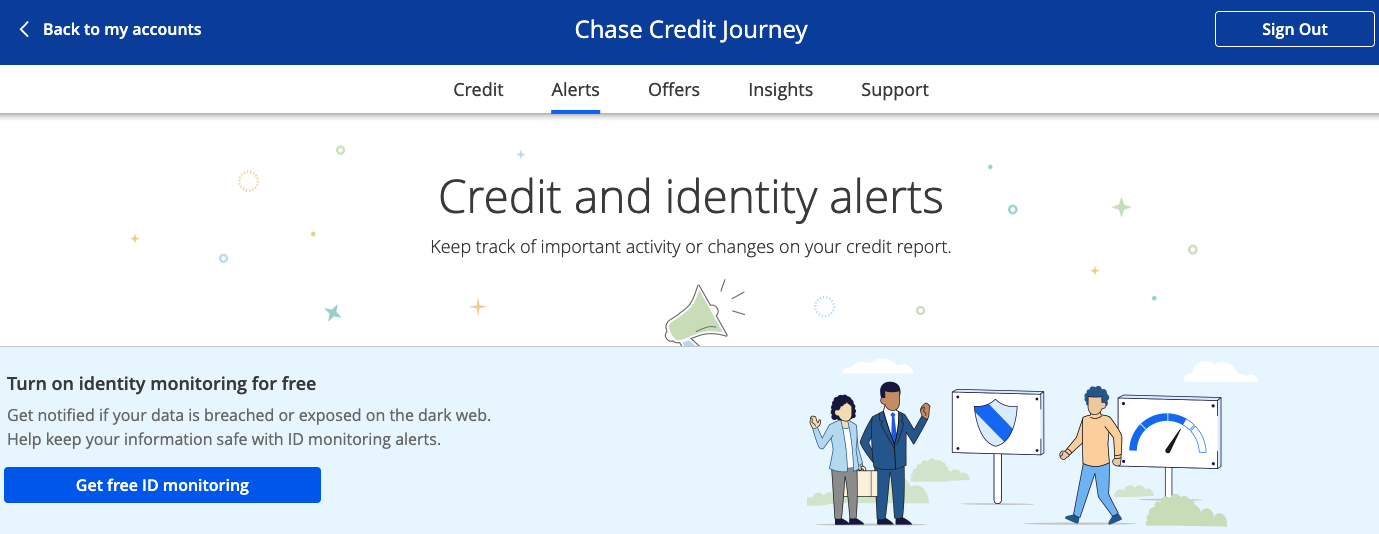
How do I turn on Chase identity monitoring
There are simple steps to sign up and check into this helpful service:
Swipe up to click on “Credit Journey.”
Enroll in Identity Monitoring and tap “Enroll.”
View your credit score then click “See all factors” impacting your score.
Start Identity Monitoring with a tap to “Alerts” and the “Alerts inbox.”
How much does bank monitoring cost
Paid credit monitoring often costs between $10 and $30 a month—money that you’d probably prefer to save or spend on take-out or a streaming service subscription. Plus, you can get similar (but less robust) credit monitoring for free through online services, banks, and credit card companies.
How can I monitor my identity theft for free
Best free credit monitoring alert services:
Best overall free service: CreditWise® from Capital One.
Runner-up: Discover Credit Scorecard.
Best for setting goals to boost your credit score: American Express® MyCredit Guide.
Best for identity theft insurance: Chase Credit Journey.
How do I know if my identity is being used without my knowledge
Regularly check your credit report and bank statements.
Check for the warning signs of identity theft — such as strange charges on your bank statement or accounts you don’t recognize. An identity theft protection service like Aura can monitor your credit and statements for you and alert you to any signs of fraud.
What are the cons of credit monitoring services
Cons of paid credit monitoring:
It costs money. Paid credit monitoring often costs between $10 and $30 a month—money that you’d probably prefer to save or spend on take-out or a streaming service subscription.
It doesn’t stop fraud or identity theft.
It won’t tell you everything.
It can’t fix mistakes.
How can I monitor if my identity has been stolen
What you can do to detect identity theft:
Track what bills you owe and when they’re due. If you stop getting a bill, that could be a sign that someone changed your billing address.
Review your bills.
Check your bank account statement.
Get and review your credit reports.
Is Chase credit monitoring free
Chase Credit Journey is a free online tool for anyone—not only Chase cardmembers—to see their credit score, credit balances, limits and credit history—all without impacting your score.
Does Chase offer free identity theft protection
Unfortunately, Chase doesn't offer any type of premium identity theft protection services. However, they do offer the standard protection that any other financial institution or bank offers for your accounts and credit cards.
Cached
Should I turn on identity monitoring
Consider paying for an identity theft protection service only if: You're already the victim of identity theft or at high risk of it. You are unwilling to freeze your credit reports. You know that you won't go through the effort of actively monitoring your own credit.
How much does identity theft monitoring cost
What Is the Average Cost of Identity Theft Protection The average cost of identity theft protection hinges on the provider, level of protection, and plan type. Generally, these services range from around $10 to $30 per month. Annual plans for both individuals and families may cost $150–$350 per year.
How do I turn on Chase identity monitoring
There are simple steps to sign up and check into this helpful service:Swipe up to click on "Credit Journey."Enroll in Identity Monitoring and tap "Enroll."View your credit score then click "See all factors" impacting your score.Start Identity Monitoring with a tap to "Alerts" and the "Alerts inbox."
How much does bank monitoring cost
Paid credit monitoring often costs between $10 and $30 a month—money that you'd probably prefer to save or spend on take-out or a streaming service subscription. Plus, you can get similar (but less robust) credit monitoring for free through online services, banks, and credit card companies.
How can I monitor my identity theft for free
Best free credit monitoring alert servicesBest overall free service: CreditWise® from Capital One.Runner-up: Discover Credit Scorecard.Best for setting goals to boost your credit score: American Express® MyCredit Guide.Best for identity theft insurance: Chase Credit Journey.
How do I know if my identity is being used without my knowledge
Regularly check your credit report and bank statements.
Check for the warning signs of identity theft — such as strange charges on your bank statement or accounts you don't recognize. An identity theft protection service like Aura can monitor your credit and statements for you and alert you to any signs of fraud.
What are the cons of credit monitoring services
Cons of paid credit monitoringIt costs money. Paid credit monitoring often costs between $10 and $30 a month—money that you'd probably prefer to save or spend on take-out or a streaming service subscription.It doesn't stop fraud or identity theft.It won't tell you everything.It can't fix mistakes.
How can I monitor if my identity has been stolen
What you can do to detect identity theftTrack what bills you owe and when they're due. If you stop getting a bill, that could be a sign that someone changed your billing address.Review your bills.Check your bank account statement.Get and review your credit reports.
Why is Chase asking me to verify my identity
Applying for a loan Recently submitted a rental application You might see an identity verification alert from Chase Credit Journey®. An identity verification alert is our way of letting you know that a business is trying to confirm who you are after an application is submitted with your personal information.
How does Chase verify your identity
When you sign in for the first time or with a device we don't recognize, we'll ask you for your username, password and a temporary identification code, which we'll send you by phone, email or text message. Once you give us the identification code, we'll sign you securely into your accounts.
What is a monitoring fee
Monitoring (or management) fees are the fees charged by the private equity firm to its portfolio company after the acquisition for ongoing oversight. Expenses are typically reimbursed separately.
How do I know if my bank account is being monitored
5 Ways You Can Tell If Your Bank Account Has Been HackedSmall unexplained payments.Unexpected notifications from your bank.A call claiming to be your bank demands information.Large transactions empty your bank account.You learn your account has been closed.
How do you check if my SSN is being used
To see if someone's using your SSN, check your credit report. You can check it online through AnnualCreditReport.com, the only authorized website for free credit reports. Or you can call their phone number at 1-877-322-8228 to request your free copy.
Is there a free version of LifeLock
It doesn't matter if you choose a monthly or yearly subscription, the first 30 days will be free and LifeLock will charge your payment method only once the trial is over. But if you want to trial the Norton 360 plus LifeLock bundle, you only get seven days and you must choose a yearly subscription.
How do you check if my identity is being used
What you can do to detect identity theftTrack what bills you owe and when they're due. If you stop getting a bill, that could be a sign that someone changed your billing address.Review your bills.Check your bank account statement.Get and review your credit reports.
Does credit monitoring hurt your score
Credit Monitoring Doesn't Affect Credit Scores
Credit scoring systems such as the FICO® Score☉ and VantageScore® use credit report data for their calculations but ignore soft inquiries, which means they have no effect on your scores.
What is the difference between credit monitoring and identity monitoring
Credit monitoring is a basic service in which you receive alerts whenever a company notices suspicious activity on your credit reports. Identity theft protection services, though, not only monitor your credit reports, but also look for fraudulent purchases or activity with your online bank or credit card accounts.
Why does my bank need to verify my identity
Identity verification is a critical process to ensure that the person who is opening a bank account or applying for loans is the person they claim to be. Bank identity verification plays an essential role in open banking, anti-money laundering (AML), and know your customer (KYC) processes.
What is monitoring cost with example
For example, the board of directors at a company acts on behalf of shareholders to monitor and restrict the activities of management. This is to ensure that behavior maximizes shareholder value. The cost of having a board of directors is therefore, at least to some extent, considered an agency monitoring cost.
Who can access your bank account without your permission
Only the account holder has the right to access their bank account. If you have a joint bank account, you both own the account and have access to the funds. But in the case of a personal bank account, your spouse has no legal right to access it.
How much cash can you withdraw without reporting to IRS
$10,000
If you withdraw $10,000 or more, federal law requires the bank to report it to the IRS in an effort to prevent money laundering and tax evasion.
How can I find out if someone is using my identity for free
How To Check If Someone Is Using Your IdentityLook for unfamiliar activity on your credit report.Check your health insurance records.Review your tax return information.Make sure you're not locked out of sensitive online accounts.Scrutinize spam emails, texts, and mail.Check for missing physical mail or stolen trash.
How do I stop my SSN from being used
There are measures you can take to help prevent further unauthorized use of your SSN and other personal information. You can lock your SSN by calling the Social Security Administration or by creating an E-Verify account. Also, you can contact all three of the nationwide CRAs to place a freeze on your credit reports.


0 Comments