
How long does it take to fix ransomware?
Summary of the Article
According to a Statista survey, the average recovery time after a ransomware attack is 22 days. However, this time can vary from only a few days to several months. The timeframe for ransomware recovery depends on several variables such as the type of encryption, forensic investigation process, and system building.
The damage from a cyber attack requires about 277 days to fix (2022). In 2021, the average ransom for organizations to recover their data was estimated to be $1.85 million – far more than the 2020 figure of $760,000.
Data recovery software: Various third-party tools exist to both extract corrupted data from storage devices and restore the impacted files. The effectiveness of the software depends on the type of ransomware impacting your system. If it’s a new ransomware, it’s not likely software will be effective.
Once ransomware has infected a system, it can be difficult — if not impossible — to remove. However, ransomware is often detected only after it is announced by an attacker, for example, via a pop-up on the screen.
Ransomware was the most common attack type for the manufacturing industry in 2021. 90% of ransomware attacks fail or result in zero losses for the victim.
They threaten to sell or publish that data to coerce an increased ransom payment. Ransom payments increased 144 percent in 2021 over 2020. The average reported ransomware payment in 2022 was $4.7 million.
Ransomware recovery typically takes a few days to a week, depending on the size and complexity of your company’s IT infrastructure. However, if you have a good backup and recovery plan in place, you can minimize the downtime and get your business back up and running as quickly as possible.
Recent research reveals that over 80% of breaches involved the use of weak or stolen passwords; as access to corporate networks and applications are increasingly through corporate mobile devices or employee personal devices under BYOD schemes, poor cyber hygiene at an individual level does have a direct impact.
The surest way to confirm malware or ransomware has been removed from a system is by doing a complete wipe of all storage devices and reinstall everything from scratch. Formatting the hard disks in your system will ensure that no remnants of the malware remain.
Out of all ransomware victims, 32 percent pay the ransom, but they only get 65 percent of their data back.
The FBI doesn’t recommend making the ransom payment since it doesn’t guarantee your data back, not to mention that the payment for the ransomware finances and encourages the cybercriminals to target more victims. For data recovery after a ransomware attack, you have other options.
15 Questions and Detailed Answers
1. What is the average time to resolve ransomware?
According to a Statista survey, the average recovery time after a ransomware attack is 22 days. However, this time can vary from only a few days to several months. The timeframe for ransomware recovery depends on several variables such as the type of encryption, forensic investigation process, and system building.
2. How long does it take to fix cyber attacks?
The damage from a cyber attack requires about 277 days to fix (2022). In 2021, the average ransom for organizations to recover their data was estimated to be $1.85 million – far more than the 2020 figure of $760,000.
3. Can data be recovered after a ransomware attack?
Data recovery software: Various third-party tools exist to both extract corrupted data from storage devices and restore the impacted files. The effectiveness of the software depends on the type of ransomware impacting your system. If it’s a new ransomware, it’s not likely software will be effective.
4. Is ransomware easy to get rid of?
Once ransomware has infected a system, it can be difficult — if not impossible — to remove. However, ransomware is often detected only after it is announced by an attacker, for example, via a pop-up on the screen.
5. What percentage of ransomware attacks are successful?
Ransomware was the most common attack type for the manufacturing industry in 2021. 90% of ransomware attacks fail or result in zero losses for the victim.
6. What is the current average ransomware payout?
They threaten to sell or publish that data to coerce an increased ransom payment. Ransom payments increased 144 percent in 2021 over 2020. The average reported ransomware payment in 2022 was $4.7 million.
7. How long can ransomware attacks last?
Ransomware recovery typically takes a few days to a week, depending on the size and complexity of your company’s IT infrastructure. However, if you have a good backup and recovery plan in place, you can minimize the downtime and get your business back up and running as quickly as possible.
8. What do 80% of cyber attacks involve?
Recent research reveals that over 80% of breaches involved the use of weak or stolen passwords; as access to corporate networks and applications are increasingly through corporate mobile devices or employee personal devices under BYOD schemes, poor cyber hygiene at an individual level does have a direct impact.
9. Does wiping a computer remove ransomware?
The surest way to confirm malware or ransomware has been removed from a system is by doing a complete wipe of all storage devices and reinstall everything from scratch. Formatting the hard disks in your system will ensure that no remnants of the malware remain.
10. What percentage of ransomware victims get their data back?
Out of all ransomware victims, 32 percent pay the ransom, but they only get 65 percent of their data back.
11. Is it better to pay ransomware?
The FBI doesn’t recommend making the ransom payment since it doesn’t guarantee your data back, not to mention that the payment for the ransomware finances and encourages the cybercriminals to target more victims. For data recovery after a ransomware attack, you have other options.
What is the average time to resolve ransomware
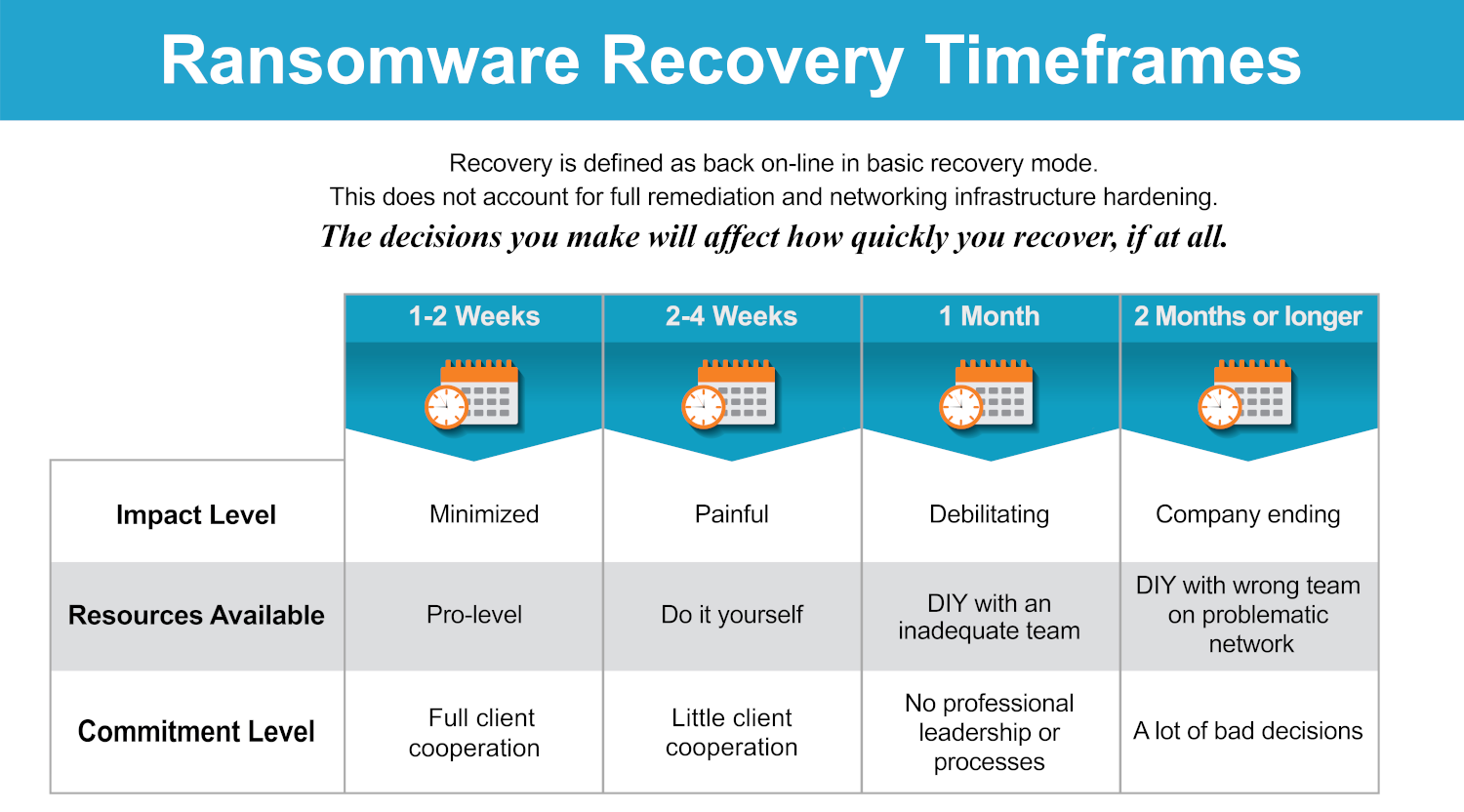
According to a Statista survey, the average recovery time after a ransomware attack is 22 days. However, this time can vary from only a few days to several months. The timeframe for ransomware recovery depends on several variables such as type of encryption, forensic investigation process, and system building.
How long does IT take to fix cyber attacks
Financial Cost of a Cyber Attack
The damage from a cyber attack requires about 277 days to fix (2022). In 2021, the average ransom for organizations to recover their data was estimated to be $1.85 million – far more than the 2020 figure of $760,000.
Can data be recovered after a ransomware attack
Data recovery software: Various third-party tools exist to both extract corrupted data from storage devices and restore the impacted files. The effectiveness of the software depends on the type of ransomware impacting your system. If it's a new ransomware, it's not likely software will be effective.
Is ransomware easy to get rid of
Once ransomware has infected a system, it can be difficult — if not impossible — to remove. However, ransomware is often detected only after it is announced by an attacker, for example, via a pop-up on the screen.
What percentage of ransomware attacks are successful
Ransomware was the most common attack type for the manufacturing industry in 2021. 90% of ransomware attacks fail or result in zero losses for the victim.
What is the current average ransomware payout
They threaten to sell or publish that data to coerce an increased ransom payment. Ransom payments increased 144 percent in 2021 over 2020. The average reported ransomware payment in 2022 was $4.7 million.
How long can ransomware attacks last
Ransomware recovery typically takes a few days to a week, depending on the size and complexity of your company's IT infrastructure. However, if you have a good backup and recovery plan in place, you can minimize the downtime and get your business back up and running as quickly as possible.
What do 80% of cyber attacks involve
Recent research[3] reveals that over 80% of breaches involved the use of weak or stolen passwords; as access to corporate networks and applications are increasingly through corporate mobile devices or employee personal devices under BYOD schemes, poor cyber hygiene at an individual level does have a direct impact on …
Does wiping a computer remove ransomware
The surest way to confirm malware or ransomware has been removed from a system is by doing a complete wipe of all storage devices and reinstall everything from scratch. Formatting the hard disks in your system will ensure that no remnants of the malware remain.
What percentage of ransomware victims get their data back
Out of all ransomware victims, 32 percent pay the ransom, but they only get 65 percent of their data back.
Is it better to pay ransomware
The FBI doesn't recommend making the ransom payment since it doesn't guarantee your data back, not to mention that the payment for the ransomware finances and encourages the cybercriminals to target more victims. For data recovery after a ransomware attack, you have other options.
What is the largest ransomware payout
| Summary | Ransom Demanded |
|---|---|
| Colonial Pipeline paid $5 Million ransom one day after cyberattack, CEO tells Senate | $5 Million |
| JBS paid $11 Million to REvil ransomware, $22.5M first demanded | $22.5 Million |
| Insurance giant CNA fully restores systems after ransomware attack | $60 Million |
| REvil gang targets Kaseya | $70 Million |
What is the average downtime for ransomware in 2023
22 days
“The average downtime following a ransomware attack is 22 days, during which the organisation incurs huge reputational and financial damage. Whilst ransomware is certainly not a new threat to organisations, such attacks have grown in frequency and severity in recent years.
What is the success rate of ransomware
Of the 32% of ransomware victims who paid the ransom in 2021, only 65% of their data was ultimately recovered. (Cloudwards)
Can ransomware be reversed
Restore From a Backup
If you have a recent backup of your data, you can restore your computer to its previous state. This will remove any ransomware that is on your device and replace it with backed-up data. To do this, you will need to boot into Safe Mode.
Where do 90% of all cyber attacks come from
Fend Off Phishing : Learn how more than 90% of all cyber attacks begin with phishing. Find out how attackers leverage phishing attacks to gain access to protected systems, hosts, and networks. Discover how technology can be used to mitigate phishing attacks and train users to better recognize phishing emails.
Which email is responsible for 91% of all cyber attacks
phishing email
Research by Deloitte found that 91% of all cyberattacks begin with a phishing email (an email that looks like it's from someone you know but is actually from criminals). That's how web giant Yahoo was targeted a few years ago, exposing the contents of half a billion user accounts to criminals.
Does ransomware steal data or just lock it
Ransomware has been one of the most popular and successful malware types these days. With it, cybercriminals can successfully block access to your own data and devices, steal sensitive information, and earn a fortune by forcing you to pay a ransom.
Is it possible to unlock ransomware
If your computer is infected with ransomware that encrypts your data, you will need an appropriate decryption tool to regain access. At Kaspersky, we are constantly investigating the latest types of ransomware so that we can provide the appropriate decryption tools to counter these attacks.
Should you pay ransom ransomware
Paying the first ransom may not solve the issue. If a business decides to comply with the ransom request, the hacker will likely request more money. Even if the hacker provides the encryption keys immediately, it could take the organization weeks or months to restore its encrypted information.
Has anyone ever paid ransomware
Of the 192 respondents who had been hit with ransomware attacks, 83% said they felt they had no choice but to pay the ransom.
How often is ransomware successful
Between May 2021 and June 2022, there were an estimated 3640 successful ransomware attacks globally. As mentioned above, these ransomware statistics use publically reported figures; it is likely more ransomware victims haven't reported breaches in security.
How much does it cost to remove ransomware
The average cost of remediating a ransomware attack more than doubled in the last 12 months. Remediation costs, including business downtime, lost orders, operational costs, and more, grew from an average of $761,106 in 2020 to $1.85 million in 2021.
What do over 90% of cyber attacks start with
Phishing
Fend Off Phishing : Learn how more than 90% of all cyber attacks begin with phishing. Find out how attackers leverage phishing attacks to gain access to protected systems, hosts, and networks. Discover how technology can be used to mitigate phishing attacks and train users to better recognize phishing emails.
What is the number one cause for most cyber attacks
Criminal hacking—it's what causes the majority of data breaches. These are planned attacks by cybercriminals always looking to exploit computer systems or networks. Some common techniques include phishing, password attacks, SQL injections, malware infection, and DNS spoofing.


0 Comments