
Is Windows quick scan accurate?
Summary of the Article
In this article, we will explore the effectiveness of the Windows Quick scan feature in terms of detecting and removing malware. We will also discuss the reliability of the Quick scan and whether a full scan is better for comprehensive threat detection. Additionally, we will examine the accuracy of Windows virus scans and their ability to detect various types of malware, including trojans. Finally, we will provide recommendations for running regular virus scans on your computer and address the possibility of false positives or negatives in Windows antivirus software.
Questions and Detailed Answers
1. How effective is the Windows Quick scan?
In most cases, a quick scan is sufficient and is the recommended option for scheduled scans. A full scan starts by running a quick scan and then continues with a sequential file scan of all mounted fixed disks and removable/network drives (if the full scan is configured to do so).
2. Is Windows security Quick scan reliable?
A quick scan isn’t enough. Full scans are a must for detecting threats. It also takes a bit of effort on your part. You need to be aware of what on your computer can allow an attacker to pull data from your computer.
3. Is a full scan better than a quick scan?
Quick Scan runs a quick check of the areas of the system most susceptible to infection. Full Scan performs a thorough check of all areas of the system. (Recommended if you suspect the computer is infected.)
4. Is Windows virus scan accurate?
Microsoft’s Defender is pretty good at detecting malware files, blocking exploits and network-based attacks, and flagging phishing sites. It even includes simple PC performance and health reports as well as parental controls with content filtering, usage limitations, and location tracking.
5. Will quick scan detect virus?
Concerned that you may have done something to introduce a suspicious file or virus to your device? Select Quick scan (called Scan now in previous versions of Windows 10) to immediately check your device for any recent threats.
6. Can a Windows full scan detect malware?
Windows Security continually scans for malware (malicious software), viruses, and security threats. In addition to this real-time protection, updates are downloaded automatically to help keep your device safe and protect it from threats.
7. Can Windows Defender detect Trojans?
How to protect against trojans? Use the following free Microsoft software to detect and remove it: Microsoft Defender Antivirus for Windows 10 and Windows 8.1, or Microsoft Security Essentials for previous versions of Windows. Microsoft Safety Scanner.
8. Which scan is most accurate?
A CT scan, or computed tomography scan, sends radiation through the body. However, unlike a simple X-ray study, it offers a much higher level of detail, creating computerized, 360-degree views of the body’s structures. CT scans are fast and detailed.
9. Which scan is the most detailed?
MRI scans are generally considered as providing more accurate imagery and are therefore used for diagnosing conditions associated with your bones, organs, or joints.
10. How often should you run a virus scan on your computer?
“Repeated scans are always recommended. We recommend once per week,” said Fabian Sanz, security researcher at Avira. “In fact, there is a default scheduled scan active in all Avira versions that is set for once every week.”
11. Can Windows antivirus be wrong?
False positives/negatives can occur with any threat protection solution, including Defender for Endpoint.
12. How do you check if my PC is infected with a virus?
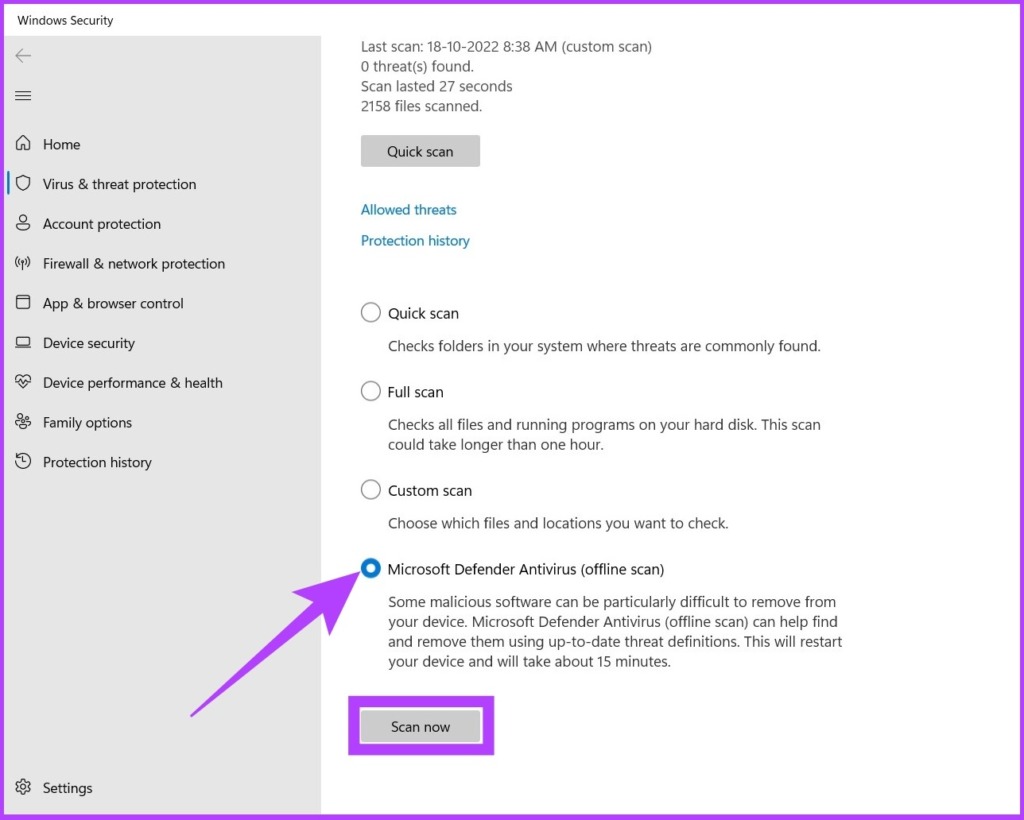
Open your Windows Security program, click “Virus & threat protection,” and then click “Quick scan” to scan your PC for malware.
How effective is the Windows Quick scan
In most cases, a quick scan is sufficient and is the recommended option for scheduled scans. A full scan starts by running a quick scan and then continues with a sequential file scan of all mounted fixed disks and removable/network drives (if the full scan is configured to do so).
Is Windows security Quick scan reliable
A quick scan isn't enough. Full scans are a must for detecting threats. It also takes a bit of effort on your part. You need to be aware of what on your computer can allow an attacker to pull data from your computer.
Is a full scan better than a quick scan
Quick Scan runs a quick check of the areas of the system most susceptible to infection. Full Scan performs a thorough check of all areas of the system. (Recommended if you suspect the computer is infected.)
Is Windows virus scan accurate
Microsoft's Defender is pretty good at detecting malware files, blocking exploits and network-based attacks, and flagging phishing sites. It even includes simple PC performance and health reports as well as parental controls with content filtering, usage limitations, and location tracking.
Cached
Will quick scan detect virus
Quick scan.
Concerned that you may have done something to introduce a suspicious file or virus to your device Select Quick scan (called Scan now in previous versions of Windows 10) to immediately check your device for any recent threats.
Can a Windows full scan detect malware
Windows Security continually scans for malware (malicious software), viruses, and security threats. In addition to this real-time protection, updates are downloaded automatically to help keep your device safe and protect it from threats.
Can Windows Defender detect Trojans
How to protect against trojans. Use the following free Microsoft software to detect and remove it: Microsoft Defender Antivirus for Windows 10 and Windows 8.1, or Microsoft Security Essentials for previous versions of Windows. Microsoft Safety Scanner.
Which scan is most accurate
A CT scan, or computed tomography scan, sends radiation through the body. However, unlike a simple X-ray study, it offers a much higher level of detail, creating computerized, 360-degree views of the body's structures. CT scans are fast and detailed.
Which scan is the most detailed
MRI scans are generally considered as providing more accurate imagery and are therefore used for diagnosing conditions associated with your bones, organs or joints.
How often should you run a virus scan on your computer
“Repeated scans are always recommended. We recommend once per week,” said Fabian Sanz, security researcher at Avira. “In fact, there is a default scheduled scan active in all Avira versions that is set for once every week.”
Can Windows antivirus be wrong
False positives/negatives can occur with any threat protection solution, including Defender for Endpoint.
How do you check if my PC is infected with virus
Open your Windows Security settings. Select Virus & threat protection > Scan options. Select Windows Defender Offline scan, and then select Scan now.
How do I find hidden malware on my computer
Open your Windows Security settings. Select Virus & threat protection > Scan options. Select Windows Defender Offline scan, and then select Scan now.
Does wiping your PC remove all malware
Running a factory reset, also referred to as a Windows Reset or reformat and reinstall, will destroy all data stored on the computer's hard drive and all but the most complex viruses with it. Viruses can't damage the computer itself and factory resets clear out where viruses hide.
Can a Trojan virus go undetected
Trojan viruses are a formidable threat to businesses and individuals. They're subtle, often go undetected, and can lead to a range of adverse effects from malware. They can grant access to sensitive data and credentials or be used to conduct special attacks and extort businesses.
How good is Windows Defender at removing viruses
Is Microsoft Defender antivirus safe Microsoft Defender antivirus is pretty safe. It has almost 100% real-time protection rates, according to independent tests. It also has additional features for device protection against malware, such as scanning, app and browser control, and account protection options.
What if MRI shows nothing but still in pain
The bottom line is that not all pain is able to be detected on an x-ray or MRI. That does not mean that there is nothing there that needs to be treated or diagnosed. In fact, it means that it is possibly a precursor to something going really wrong and then eventually needing surgery because it eventually winds up torn.
How long will a stroke show up on an MRI
Summary. An MRI can show signs of a stroke years or even decades after the stroke happens. Sometimes, a person may not know they had a stroke until a long time afterward. MRI is the most accurate way to view signs of stroke inside the brain, but a CT scan is often faster and more widely available.
How do I get the highest quality scan
How to scan high quality, high resolution imagesCarefully clean and dry the scanner's glass plate.Gently wipe your photo free of dust with a soft, dry cloth.Set your printer/scanner to save as high resolution jpegs, at 300 or 600 dpi.Opt for colour scanning, even if the photo is black and white.
Does Windows full scan remove virus
Windows Security continually scans for malware (malicious software), viruses, and security threats. In addition to this real-time protection, updates are downloaded automatically to help keep your device safe and protect it from threats.
Are full virus scans necessary
Quick scan may not detect some malware, but it can still inform you about a virus if your computer is infected. Full Scan requires much more time and OS resources but it detects all known viruses. We recommend performing a Full Scan every week.
Does Windows Defender give false positives
False positives/negatives can occur with any threat protection solution, including Defender for Endpoint. Fortunately, steps can be taken to address and reduce these kinds of issues.
Is Windows 10 built in antivirus good enough
Is Windows Defender good enough Yes, Windows Defender is a good basic virus protection software. You may not find everything you want if you are extremely security focused. A third-party antivirus or anti-malware software will likely find threats that Windows Defender may miss.
What are 5 signs that your PC may have been infected with malware
Follow this guide to learn more about the signs of malware and how you can diagnose and treat a malware infection.Slow performance.Unexpected freezing or crashing.Diminished storage space.Homepage randomly changes.Browser redirects.New browser toolbars.Annoying pop-ups.Unusual error messages.
What are the 4 symptoms of computer virus
If you notice any or all these symptoms, your computer might have a virus and you should act:Suddenly slow computer performance, meaning it takes a noticeably longer time to start up or open programs.Problems unexpectedly shutting down or restarting.Missing files.Frequent system crashes.Frequent error messages.


0 Comments