
What are the data privacy regulations?
Summary of the Article: Data Privacy Regulations
What are the 5 states with data privacy laws?
On May 10, 2022, Connecticut became the fifth state to enact a comprehensive privacy law to protect personal data, joining California, Virginia, Colorado, and Utah.
What are the 8 data privacy rights?
Under Chapter IV of the Act, there are eight (8) rights that belong to data subjects:
- The right to be informed
- The right to access
- The right to object
- The right to erasure and blocking
- The right to rectify
- The right to file a complaint
- The right to damages
- The right to data portability
Which are the 4 basic principles of data privacy?
The four basic principles of data privacy are:
- Accuracy
- Storage limitation
- Integrity and confidentiality (security)
- Accountability
What are the 3 principles of the data privacy Act?
The processing of personal data shall be allowed subject to adherence to the principles of transparency, legitimate purpose, and proportionality. The three principles are:
- Transparency
- Legitimate purpose
- Proportionality
What are the data privacy regulations under CCPA?
According to the CCPA, businesses that sell personal information are required to provide a clear and conspicuous “Do Not Sell or Share My Personal Information” link on their website for users to submit an opt-out request. Businesses cannot mandate the creation of an account to submit the request.
How many privacy laws exist in the US?
The right to privacy in the US is protected by more than 600 laws in the states and by a dozen federal laws, including those safeguarding health and student information and limiting electronic surveillance.
What are the 7 principles of a privacy policy?
The seven principles of a privacy policy are:
- Lawfulness, Fairness, and Transparency
- Purpose Limitation
- Data Minimization
- Accuracy
- Storage Limitations
- Integrity and Confidentiality
- Accountability
What are the five key privacy principles?
The five key privacy principles are:
- Be accountable
- Identify the purpose
- Obtain consent
- Limit collection
- Limit use, disclosure, and retention
- Be accurate
- Use appropriate safeguards
- Be open
What are the 6 data privacy principles?
The six data privacy principles are:
- Lawfulness, Fairness, and Transparency
- Limitations on Purposes of Collection, Processing, and Storage
- Data Minimization
- Accuracy of Data
What are the 7 principles of data protection law?
The seven principles of data protection law are:
- Lawfulness, Fairness, and Transparency
- Purpose Limitation
- Data Minimization
- Accuracy
- Storage Limitation
- Integrity and Confidentiality
- Accountability
What is the golden rule for data privacy?
The golden rule for data privacy is based on two key concepts:
- Honesty: Companies must be honest about the data collected, used, bought, or sold
- Transparency: Companies need to provide clear and straightforward data collection policies, regardless of users’ level of tech-savviness
What’s the difference between GDPR and CCPA?
The CCPA is an American data privacy law that applies only to California residents, while the GDPR is a European Union regulation that applies to all EU citizens and residents. The GDPR has stricter requirements and provides more rights to individuals in terms of data privacy and protection.
What are the 5 states data privacy laws
On May 10, 2022, Connecticut became the fifth state to enact a comprehensive privacy law to protect personal data, joining California, Virginia, Colorado and Utah.
What are the 8 data privacy rights
Under Chapter IV of the Act, there are eight (8) rights that belong to data subjects, namely: the right to be informed; the right to access; the right to object; the right to erasure and blocking; the right to rectify; the right to file a complaint; the right to damages; and the right to data portability.
Which are the 4 basic principles of data privacy
Accuracy. Storage limitation. Integrity and confidentiality (security) Accountability.
What are the 3 principles of the data privacy Act
Principles of Transparency, Legitimate Purpose and Proportionality. The processing of personal data shall be allowed subject to adherence to the principles of transparency, legitimate purpose, and proportionality. a. Transparency.
What are data privacy regulations CCPA
Businesses that sell personal information are subject to the CCPA's requirement to provide a clear and conspicuous “Do Not Sell or Share My Personal Information” link on their website that allows you to submit an opt-out request. Businesses cannot require you to create an account in order to submit your request.
How many privacy laws are there in the US
The right to privacy is protected also by more than 600 laws in the states and by a dozen federal laws, like those protecting health and student information, also limiting electronic surveillance.
What are the 7 principles of privacy policy
The principles are: Lawfulness, Fairness, and Transparency; Purpose Limitation; Data Minimisation; Accuracy; Storage Limitations; Integrity and Confidentiality; and Accountability.
What are the five key privacy principles
Ten Principles of Privacy ProtectionBe accountable.Identify the purpose.Obtain consent.Limit collection.Limit use, disclosure and retention.Be accurate.Use appropriate safeguards.Be open.
What are the 6 data privacy principles
Lawfulness, Fairness, and Transparency. Limitations on Purposes of Collection, Processing, and Storage. Data Minimization. Accuracy of Data.
What are the 7 principles of data protection law
Lawfulness, fairness, and transparency; ▪ Purpose limitation; ▪ Data minimisation; ▪ Accuracy; ▪ Storage limitation; ▪ Integrity and confidentiality; and ▪ Accountability. These principles are found right at the outset of the GDPR, and inform and permeate all other provisions of that legislation.
What is the golden rule for data privacy
HONESTY – Companies must be honest about the data collected, used, bought, or sold. TRANSPARENCY – Companies need to stop burying data collection policies deep within lengthy legal documents and instead be straightforward with all consumers (regardless of their level of tech-savviness) regarding data privacy practices.
What’s the difference between GDPR and CCPA
The CCPA is an American state law that focuses exclusively on protecting the privacy of California residents. The GDPR is a European Union (EU) regulation that protects the personal data of those living in the EU by imposing strict data protection requirements and strict penalties for non-compliance.
What is GDPR vs CCPA vs LGPD
CCPA allows businesses to retain, collect, and sell anonymous, aggregated, and de-identified data without disclosure. GDPR only allows businesses to retain, collect, and sell anonymous data without disclosure. LGPD doesn't have any language relating to these types of data, meaning that they must be disclosed.
What is the most protective data privacy law in the United States
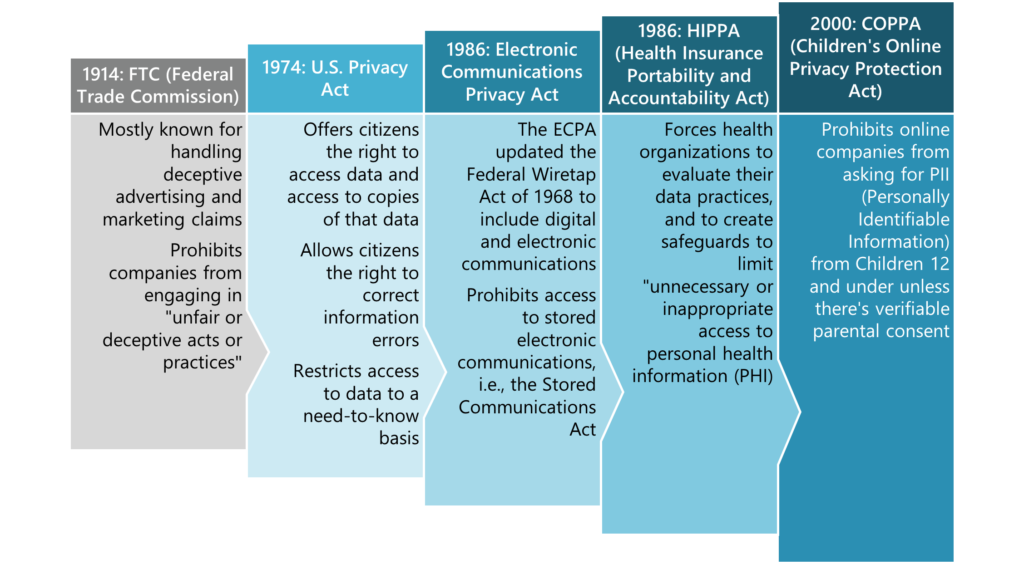
The federal government passed the U.S. Privacy Act of 1974 to enhance individual privacy protection. This act established rules and regulations regarding U.S. government agencies' collection, use, and disclosure of personal information.
What are the privacy acts in the US
The Privacy Act of 1974, as amended to present, including Statutory Notes (5 U.S.C. 552a), Protects records about individuals retrieved by personal identifiers such as a name, social security number, or other identifying number or symbol.
What are the 6 main principles of GDPR
The data protection principles that would be impacted include 1 – lawful, fair and transparent; 2 – limited for its purpose and 6 – integrity and confidentiality. Data that is collected for deceptive or misleading purposes is not fair and may not be lawful.
What are the six 6 essential data protection methods
We take a look at each principle in this blog, and provide advice on how they should fit within your GDPR compliance practices.Lawfulness, fairness and transparency.Purpose limitation.Data minimisation.Accuracy.Storage limitation.Integrity and confidentiality.
What are the most important data privacy principles
Generally, these principles include: Purpose limitation. Fairness, lawfulness, and transparency. Data minimization.
What is the US equivalent of the GDPR
California Consumer Privacy Act
What is the US equivalent of GDPR The CCPA (California Consumer Privacy Act) is the US equivalent of GDPR. This comprehensive data privacy act gives Californian residents greater transparency and control over how businesses collect and use their personal information.
What is the biggest difference between GDPR and CCPA
The difference between GDPR and CCPA is that the CCPA's definition is extra-personal, meaning that it includes data that is not specific to an individual, but is categorized as household data, whereas the GDPR remains exclusively individual.
Which is better GDPR or CCPA
However, GDPR has a broader scope of applicability, given that it protects the data of all EU citizens. CCPA is specific to California residents. It provides more user rights and offers slightly better privacy control to users especially when it comes to opt-in consent.
Are there privacy regulations in the US
The Privacy Act of 1974, as amended, 5 U.S.C. § 552a , establishes a code of fair information practices that governs the collection, maintenance, use, and dissemination of information about individuals that is maintained in systems of records by federal agencies.
Does the US have data protection laws
There is no single principal data protection legislation in the United States (U.S.). Rather, a jumble of hundreds of laws enacted on both the federal and state levels serve to protect the personal data of U.S. residents.
What are the 7 overarching GDPR principles
The principles are: Lawfulness, Fairness, and Transparency; Purpose Limitation; Data Minimisation; Accuracy; Storage Limitations; Integrity and Confidentiality; and Accountability.
What are the 9 principles of GDPR
Lawfulness, fairness, and transparency; ▪ Purpose limitation; ▪ Data minimisation; ▪ Accuracy; ▪ Storage limitation; ▪ Integrity and confidentiality; and ▪ Accountability. These principles are found right at the outset of the GDPR, and inform and permeate all other provisions of that legislation.


0 Comments