
Is ADT-1 mandatory for OPC?
Is filing ADT 1 mandatory?
All companies, whether listed, unlisted, public, private, or any other type, are mandatorily required to file Form ADT 1. It is the responsibility of the company to file this form, not the auditor. Even if the appointment of the auditor is for a casual opening, the company still has to file Form ADT 1.
Is ADT 1 optional?
Filing of form ADT-1 is not mandatory for the first auditor if the company’s auditor is appointed for the first year after its incorporation.
Is the first auditor appointment mandatory?
Section 139(6) of the Companies Act, 2013 provides that the first auditor of a Company, other than a Government Company, shall be appointed by the Board of Directors within 30 days from the date of registration of the Company.
What is the applicability of ADT 1?
Form ADT-1 is used by a company to intimate the registrar of companies about the appointment of an auditor after the completion of its annual general meeting (AGM). Section 139(1) of the Companies Act 2013 mandates this form to be filed at the time of auditor appointment at AGM.
What is the penalty for not filing ADT 1?
Penalty For Non-filing ROC Form ADT 1:
| Sr.No | Delay in Filing (No of days) | Penalty/Late Fees |
|---|---|---|
| 1 | Upto 30 | 2 times of Normal Fees |
| 2 | More than 30 to 60 | 4 times of Normal Fees |
| 3 | More than 60 to 90 | 6 times of Normal Fees |
| 4 | More than 90 to 180 | 10 times of Normal Fees |
Is ADT 1 filed annually?
Form ADT-1 works as an intimation to the ROC by every company that appoints an auditor after holding their Annual General Meeting (AGM). This form must be filed every year with the ROC after the conclusion of the AGM and the appointment of the auditor.
Can ADT 1 be filed without filing ADT-3?
Yes, ADT-3 should be filed by every auditor at the time of resignation, irrespective of whether the company is a public company, private limited company, or government company.
Is ADT-3 required for the first auditor?
An auditor must file a statement in the form of ADT-3 form after giving notice of resignation to the company. This statement must be provided to the RoC within 30 days of the resignation date. The Auditor’s Resignation Act, Section 140(2), allows an auditor to resign.
What happens if the first auditor is not appointed?
If at an annual general meeting, no auditors are appointed or reappointed, the board of directors appoints a person to fill the vacancy.
What happens if members fail to appoint the first auditor?
If the board fails to appoint such an auditor within the next 30 days, it shall inform the members of the company, who shall appoint such an auditor within 60 days at an extraordinary general meeting. Such an auditor shall hold office till the conclusion of the first annual general meeting.
Who is required to have a federal single audit?
Any non-federal entity that expends $750,000 or more in federal award funds during its fiscal year is required to obtain a Single Audit (or Program-specific Audit if applicable).
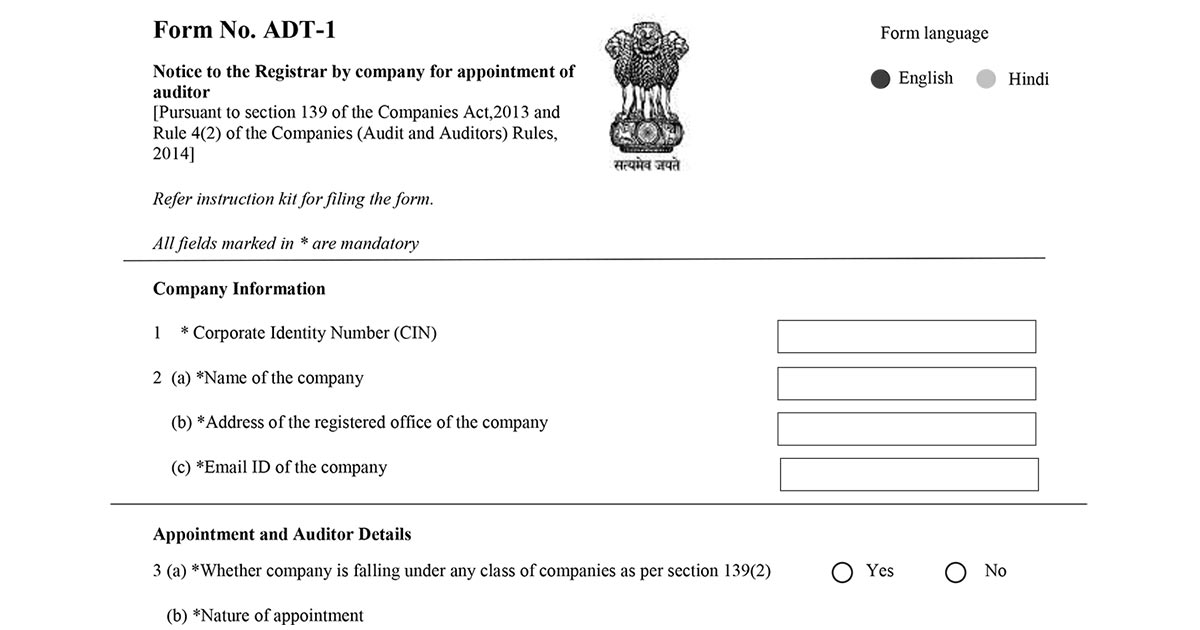
Is filing ADT 1 mandatory
All the companies are mandatorily required to file Form ADT 1, be it a listed, unlisted, public, private, or any other company. The only company responsible to file Form ADT 1 and not the auditor. The company has to file Form ADT 1 even when the appointment of the auditor is for a casual opening.
Is ADT 1 optional
Filing of form ADT-1 is not mandatory for the first auditor if a company's auditor is appointed for the first year after its incorporation.
Is first auditor appointment mandatory
Section 139(6) of the Companies Act, 2013 provides that the first auditor of a Company, other than a Government Company, shall be appointed by the Board of Directors within 30 days from the date of registration of the Company.
What is the applicability of ADT 1
Form ADT-1 is used by a company to intimate the registrar of companies about the appointment of an auditor after the completion of its annual general meeting (AGM). Sec 139 (1) of the Companies Act 2013 mandates this and this form has to be filed at the time of appointment of auditor at AGM.
What is the penalty for not filing ADT 1
Penalty For Non-filing ROC Form ADT 1
| Sr.No | Delay in Filing (No of days) | Penalty/Late Fees |
|---|---|---|
| 1 | Upto 30 | 2 times of Normal Fees |
| 2 | More than 30 to 60 | 4 times of Normal Fees |
| 3 | More than 60 to 90 | 6 times of Normal Fees |
| 4 | More than 90 to 180 | 10 times of Normal Fees |
Is ADT 1 filed annually
Form ADT- 1 works basically as an intimation to the ROC by every company which appoints an auditor after holding their Annual General Meeting (AGM). This form must be filed every year with the ROC after the conclusion of the AGM, and appointment of the auditor.
Can ADT 1 be filed without filing ADT-3
Yes. ADT-3 should be filed by every auditor at the time of resignation irrespective of whether the company is a public company, private limited company or government company.
Is ADT-3 required for first auditor
An auditor must file a statement in the form of ADT-3 form after giving notice of resignation to the company. Within 30 days of the resignation date, this statement must be provided to the RoC. The Auditor's Resignation Act, Section 140(2), allows an auditor to resignation.
What happens if the first auditor is not appointed
Therefore, If at an annual general meeting, no auditors are appointed or reappointed, the board of directors appoints a person to fill the vacancy.
What happens if members fail to appoint first auditor
If the board fails to appoint such auditor within the next 30 days, it shall inform the members of the company who shall appoint such auditor within 60 days at an extraordinary general meeting. Such auditor shall hold office till the conclusion of the first annual general meeting.
Who is required to have a federal single audit
What triggers the requirement for a Single Audit Any non-federal entity that expends $750,000 or more in federal award funds during its fiscal year is required to obtain a Single Audit (or Program-specific Audit, if applicable.)
Who is subject to the Single Audit Act
The Single Audit Act requires an annual audit of non-Federal entities, including Tribes, that expend $750,000 or more of Federal Financial Assistance in a fiscal year.
Can ADT 1 be filed after 300 days
According to the Companies Act 2013, the Form ADT-1 must be filed with the Registrar of Companies (ROC) within 15 days of the Annual General Meeting at which the Auditor was appointed or reappointed. In the case of a newly incorporated company, the Form ADT-1 must be filed within 15 days of the first board meeting.
What if the auditor does not file ADT-3
As per section 140(3), if the auditor fails to file ADT-3 within time limit then he will be liable to pay a penalty of INR 50,000 or amount equal to his remuneration, whichever is less.
What happens if first auditor is not appointed within 90 days
The board shall inform the members of the company regarding this failure. The company Conduct Extra Ordinary General Meeting by sending notice to members and appoint auditor within 90 days from the date of failure to appoint.
Under what circumstances is a company not required to appoint an auditor
Requirements when choosing an auditor
An auditor must be independent of the company. Therefore, you cannot appoint a person as an auditor if they are: an officer or employee of the company or an associated company. a partner or employee of such a person, or a partnership of which such a person is a partner.
What if first auditor is not appointed within 30 days
If the board fails to appoint such auditor within the next 30 days, it shall inform the members of the company who shall appoint such auditor within 60 days at an extraordinary general meeting. Such auditor shall hold office till the conclusion of the first annual general meeting.
How do you know if a Single Audit is required
What triggers the requirement for a Single Audit Any non-federal entity that expends $750,000 or more in federal award funds during its fiscal year is required to obtain a Single Audit (or Program-specific Audit, if applicable.)
Which type of audits are mandatory
A statutory audit is a mandatory audit of a company's financial records by an external entity. This audit is mandated by statute or law that governs an organization's principles and ethics.
How do you know if a single audit is required
What triggers the requirement for a Single Audit Any non-federal entity that expends $750,000 or more in federal award funds during its fiscal year is required to obtain a Single Audit (or Program-specific Audit, if applicable.)
Who is required to be audited
All public companies must undergo an independent audit every year. This ensures that the financial statements released by the company accurately reflect its operations. At the end of the audit engagement, the auditors prepare a written audit report that they file with the Securities and Exchange Commission (SEC).
What happens if first auditor is not appointed
Therefore, If at an annual general meeting, no auditors are appointed or reappointed, the board of directors appoints a person to fill the vacancy.
What happens if a company fails to appoint first auditor
Further in case the board also fails to appoint such auditor within the stipulated timeframe, the members of the company shall endeavour to appoint such auditor within the next 60 days at a duly convened Extraordinary General Meeting.
What companies are exempt from audit
Companies. Companies that qualify as small companies under Companies Act 2006 are usually exempt from audit, unless they are members of a group or are charities and required to follow the charity audit thresholds.
Which companies are required to appoint auditors
(1) Upon its incorporation, and each year at its annual general meeting, a public company or state- owned company must appoint an auditor.


0 Comments