
What jobs can AI not replace?
and improve efficiency in healthcare, it is unlikely that AI will fully replace nurses. Nurses play a crucial role in providing personalized care, emotional support, and human connection to patients, which are essential aspects of patient care that cannot be replicated by AI.
Furthermore, nurses perform various tasks that require critical thinking, adaptability, and decision-making skills, such as assessing and monitoring patients, administering medications, and managing emergencies. These tasks often involve complex situations where human judgment and empathy are necessary.
Additionally, nurses serve as advocates for their patients, ensuring their needs are met and their voices are heard. They collaborate with other healthcare professionals to develop and implement care plans, provide education to patients and their families, and offer emotional support during difficult times.
Although AI can assist nurses in certain aspects of their work, such as streamlining administrative tasks and analyzing medical data, it cannot replace the human touch and intuition that nurses bring to patient care. AI may enhance and complement nurses’ roles, but it cannot replace the holistic and compassionate care that nurses provide.
1. Can AI replace therapists, social workers, and nurses?
No, jobs that require high emotional intelligence, such as therapists, social workers, and nurses, are not likely to be replaced by AI. These roles involve human connection, empathy, and personalized care, which AI cannot replicate.
2. Which job roles are at risk of disappearing with AI?
Some job roles that are at risk of disappearing with AI include computer programmers, social media teams, web and graphic designers, proofreaders and translators, and healthcare assistants.
3. Which jobs will never be automated by AI?
Some jobs that are unlikely to be automated by AI in the foreseeable future include teachers, lawyers and judges, directors, managers and CEOs, politicians, HR managers, singers, psychologists and psychiatrists, and priests and other spiritual figures.
4. Which jobs are most at risk from AI?
AI is expected to have a significant impact on the manufacturing, customer service, retail, finance, and healthcare sectors. Manufacturing is already experiencing a considerable impact from AI.
5. What can never be replaced by technology?
Certain things are better experienced in person and cannot be replaced by technology, such as handshakes, physical gestures of comfort, intimate interactions, sensory experiences, and personal connections.
6. What are the limitations of AI?
AI is unable to answer questions requiring inference, nuanced understanding of language, and broad understanding of multiple topics. While it has been taught to pass standardized eighth-grade and high-school science tests, it is yet to pass a college entrance exam.
7. Which four jobs are expected to disappear the fastest?
According to the World Economic Forum (WEF), bank tellers, postal service clerks, cashiers and ticket clerks, and data entry clerks are expected to decline rapidly. However, other jobs may also be affected by AI.
8. Which jobs are projected to disappear by 2027?
Approximately 26 million clerical jobs, including cashiers and ticket clerks, data entry, accounting, bookkeeping and payroll clerks, and administrative and executive secretaries, are expected to disappear by 2027.
9. What jobs are likely to be obsolete in 20 years?
Some jobs that are expected to be gone within 20 years include travel agents, cashiers, bank tellers, drivers, newspapers, fast-food workers, telemarketing, and warehouse workers.
10. What are some risks of artificial intelligence?
Risks of artificial intelligence include automation-spurred job loss, privacy violations, deepfakes, algorithmic bias caused by bad data, socioeconomic inequality, market volatility, and weapons automatization.
11. Will AI replace nurses?
While AI can assist nurses in certain aspects of their work, it is unlikely to fully replace nurses. Nurses provide personalized care, emotional support, critical thinking, and advocacy for patients, which cannot be replicated by AI. AI can complement and enhance nurses’ roles, but it cannot replace the holistic and compassionate care they provide.
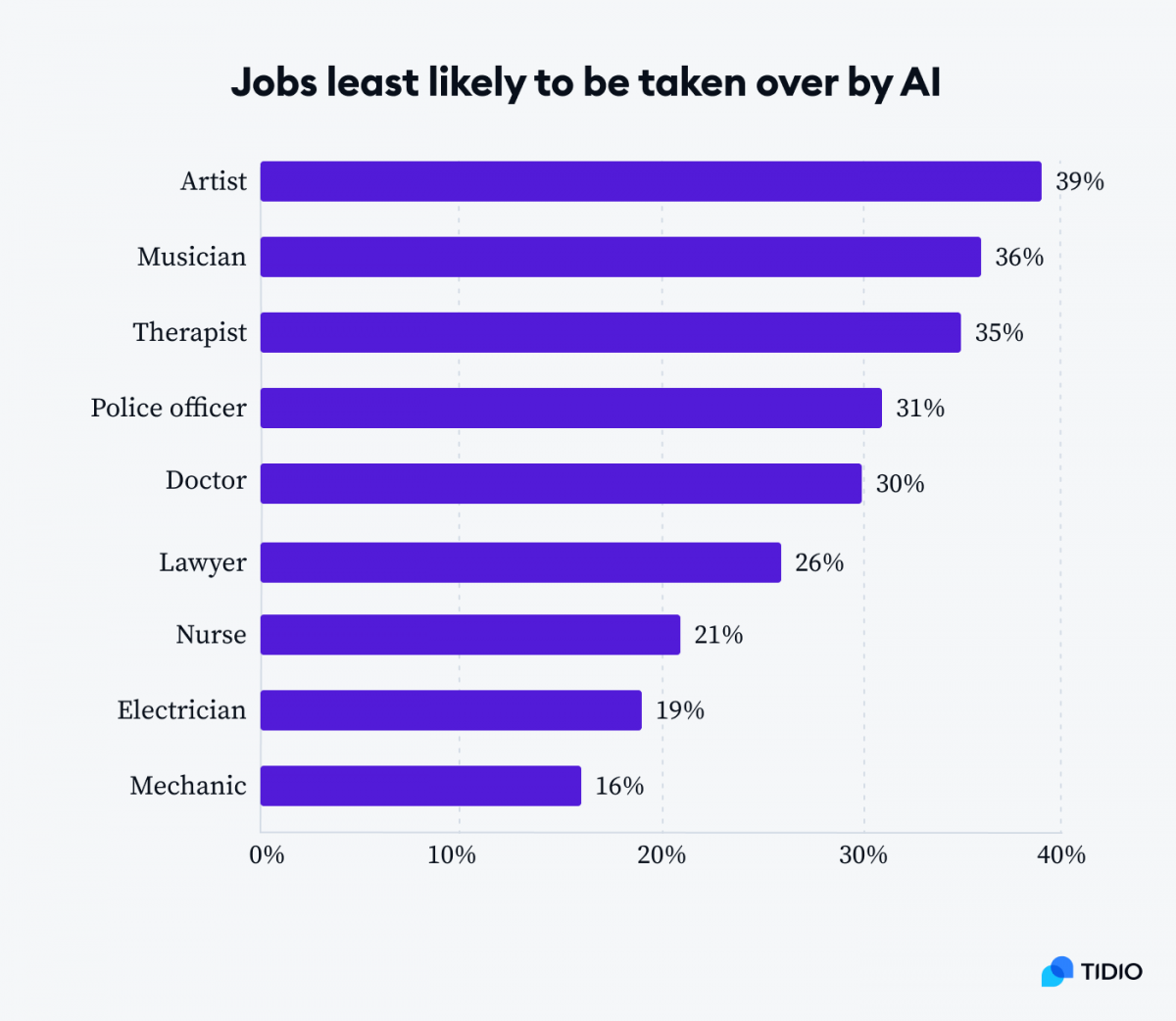
Which job cannot be replaced by AI
As such, jobs that require high emotional intelligence, such as therapists, social workers, and nurses, are not likely to be replaced by AI. Specialized Professionals: Jobs that require deep expertise in a particular field, such as doctors, lawyers, and scientists, are less likely to be fully replaced by AI.
Cached
What jobs will disappear with AI
5 Job Roles in Danger of Disappearing Because of Generative AIComputer Programmers.Social Media Teams.Web and Graphic Designers.Proofreaders and Translators.Healthcare Assistants.
Cached
Which jobs will never be automated
These are some of the jobs that are near-impossible that AI will be able to replace them in the coming years.Teachers:Lawyers and Judges.Directors, Managers and CEOs.Politicians.HR Managers.Singers.Psychologists and Psychiatrists.Priests and other spiritual figures.
Which jobs are most at risk from AI
"If I were to pick out five areas where I think AI will have the most significant impact on the future of work, I'd say it would be: manufacturing, customer service, retail, finance and healthcare. "Manufacturing is one of the industries already seeing the biggest impact from AI.
What could never be replaced by technology
Some Things Are Just Better in PersonYou Can't Fax a Handshake.You Can't Pat a Voicemail on the Back.You Can't Tickle a Voicemail.You Can't Fax a Pillow Fight.You Can't Slow Dance Online.You Can't Have Coffee With a Website.You Can't Smell Homemade Bread on Your Pager (It's extinct…)You Can't Email a Kiss.
What can AI not do
AI cannot answer questions requiring inference, a nuanced understanding of language, or a broad understanding of multiple topics. In other words, while scientists have managed to "teach" AI to pass standardized eighth-grade and even high-school science tests, it has yet to pass a college entrance exam.
What are the 4 jobs that will disappear
The WEF expects four in particular to decline the fastest: bank tellers, postal service clerks, cashiers and ticket clerks, and data entry clerks. And even if your job isn't on this list, you may not be immune.
What jobs will disappear by 2027
Twenty-six million clerical jobs are expected to disappear by 2027, including cashiers and ticket clerks, data entry, accounting, bookkeeping and payroll clerks and administrative and executive secretaries.
What jobs will be obsolete in 20 years
13 Jobs That Will Be Gone Within 20 YearsTravel agents. Technology has undermined the role of the travel agent.Cashiers. With more than 3.3 million people working in this capacity, the job of cashier isn't going to disappear anytime soon.Bank tellers.Drivers.Newspapers.Fast-food workers.Telemarketing.Warehouse workers.
What are 4 risks of artificial intelligence
Risks of Artificial IntelligenceAutomation-spurred job loss.Privacy violations.Deepfakes.Algorithmic bias caused by bad data.Socioeconomic inequality.Market volatility.Weapons automatization.
Will AI replace nurses
In conclusion, while the development and advancement in technology and AI is a boon and helps reduce (human)physician/nursing errors in diagnosis and treatment of patients , I believe that it cannot replace humans completely and should have a collaborative approach and be used as a tools/means to aid physicians/nurses …
Why AI will never replace humans
AI Can't Compete With Human Originality
AI can perform many tasks with high accuracy and efficiency, but it still lacks the ability to think creatively and come up with original ideas that resonate with human emotions and experiences and speak to a brand's unique character.
What are the four limitations of AI
Therefore, it is important to understand and address these limitations in order to fully harness the potential of AI.Limited understanding of context.Lack of common sense.Bias.Lack of creativity.Lack of Emotion.Lack of robustness.
What are 2 jobs that no longer exist
Here are 51 jobs that are no longer around:Leech collector. A leech collector was responsible for retrieving the blood-sucking worms from their natural habitat for doctors to use.Knocker upper.Hush shopkeeper.Alchemist.Gandy dancer.Human computer.Caddy butcher.Phrenologist.
What jobs will be obsolete in 5 years
A report released by the World Economic Forum (WEF) claims that AI and smart technologies will put job roles such as bank teller, cashier, and data entry clerk at risk. These roles could become obsolete in the next five years.
What jobs won t exist in 5 years
Jobs to decrease in demand by 2025Data entry clerks.Administrative and executive secretaries.Accounting, bookkeeping and payroll clerks.Accountants and auditors.Assembly and factory workers.Business services and administration managers.Client information and customer service workers.General and operations managers.
What jobs will not exist in 20 years
13 Jobs That Will Be Gone Within 20 YearsTravel agents. Technology has undermined the role of the travel agent.Cashiers. With more than 3.3 million people working in this capacity, the job of cashier isn't going to disappear anytime soon.Bank tellers.Drivers.Newspapers.Fast-food workers.Telemarketing.Warehouse workers.
What jobs are least at risk from AI
According to the report, jobs in agriculture, mining and manufacturing are the least exposed to generative AI, while jobs in the information processing industries, like IT, are the most exposed because jobs that use "programming and writing skills" are more closely related to GPT's capabilities.
What is Elon Musk’s warning about AI
Tesla Inc.
CEO Elon Musk, renowned for his outspoken warnings about the potential dangers of artificial intelligence (AI), has once again cautioned about the risks posed by a “benign dependency” on these complex machines, tweeting that it can be dangerous to civilization.
What is the biggest problem in AI
6 AI Implementation Challenges To Keep In MindInsufficient Or Low-Quality Data. AI systems function by being trained on a set of data relevant to the topic they are tackling.Outdated Infrastructure.Integration Into Existing Systems.Lack Of AI Talent.Overestimating Your AI System.Cost Requirements.
Will teachers be replaced by AI
Here's what it said, “It is unlikely that AI will completely replace teachers in the near future.”
Can AI take over doctors
“Doctors will not be replaced by AI, but they may not directly profit from it either,” Dranove says. And it's not clear if even the healthcare organization will get monetary rewards. Medical care in the United States is often based on a fee-for-service model.
Will AI take over humanity yes or no
It's unlikely that a single AI system or application could become so powerful as to take over the world. While the potential risks of AI may seem distant and theoretical, the reality is that we are already experiencing the impact of intelligent machines in our daily lives.
What are 2 disadvantages of AI
Disadvantages of Artificial IntelligenceHigh Costs. The ability to create a machine that can simulate human intelligence is no small feat.No Creativity. A big disadvantage of AI is that it cannot learn to think outside the box.Unemployment.4. Make Humans Lazy.No Ethics.Emotionless.No Improvement.
What AI systems Cannot do
AI cannot answer questions requiring inference, a nuanced understanding of language, or a broad understanding of multiple topics. In other words, while scientists have managed to "teach" AI to pass standardized eighth-grade and even high-school science tests, it has yet to pass a college entrance exam.


0 Comments