
What are PII examples?
Summary
Personally identifiable information (PII) refers to sensitive data that can be used to identify, contact, or locate an individual. Examples of PII include social security numbers, passport numbers, driver’s license numbers, taxpayer identification numbers, patient identification numbers, and financial account or credit card numbers.
Non-PII information, on the other hand, typically does not serve as a means to identify a person. It includes details such as business phone numbers, race, religion, gender, workplace, and job titles.
There are three main types of personal information: private information, sensitive personal data information, and health information.
Protected Health Information (PHI) is a specific type of personal information that falls under HIPAA regulations. HIPAA identifies 18 elements that qualify as PHI. Data used in research that is not considered PHI is categorized as Personally Identifiable Information (PII) and is not subject to the HIPAA Privacy and Security Rules.
Protected PII refers to an individual’s first name or first initial and last name in combination with other information such as social security numbers, passport numbers, credit card numbers, clearances, bank numbers, and biometrics.
PII that is not considered PHI includes information such as social security numbers, passport numbers, driver’s license numbers, addresses, email addresses, photos, biometric data, medical information, educational information, financial information, and employment information.
Non-personally identifiable information (non-PII) cannot be used to trace or identify a person. Examples of non-PII include aggregated statistics on the use of a product or service and partially or fully masked IP addresses.
The main difference between personal information and PII is that PII is used to differentiate one person from another, while personal data includes any information related to a living individual, regardless of its ability to distinguish them from another individual.
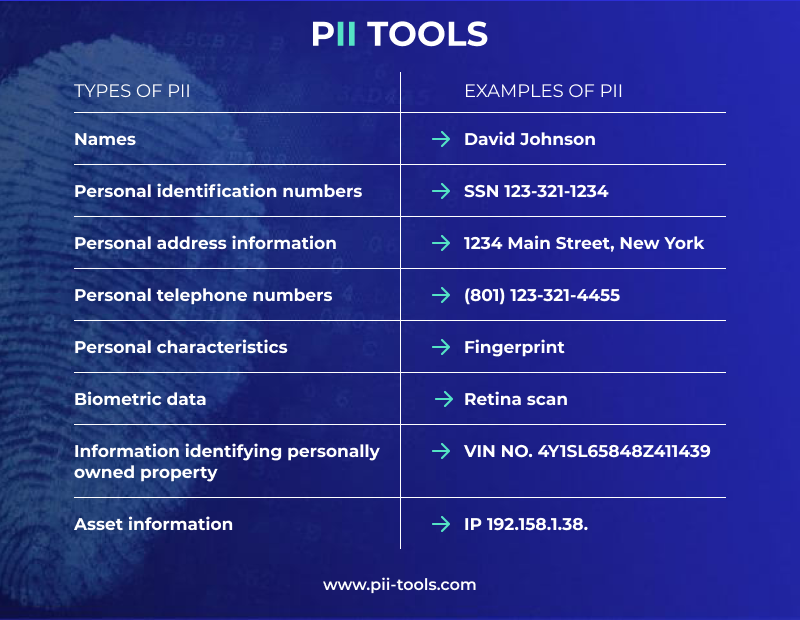
Some common examples of PII include full name, home address, email address, social security number, passport number, driver’s license number, credit card numbers, and date of birth.
PII that is not protected health information refers to personal information that is not covered by HIPAA regulations. This can include various types of data, depending on the context.
Questions:
- What is considered PII?
- What is not considered PII?
- What are the types of personal information?
- What is considered PII under HIPAA?
- What is protected under PII?
- What is considered PII but not PHI?
- What are examples of PII under HIPAA?
- Which data is not considered PII?
- What is the difference between personal information and PII?
- Which types of information are examples of PII?
- What is PII but not protected health information?
PII refers to sensitive data that can be used to identify, contact, or locate an individual. Some examples include social security numbers, passport numbers, and credit card numbers.
Non-PII information includes details such as business phone numbers, race, religion, gender, workplace, and job titles.
The types of personal information include private information, sensitive personal data information, and health information.
Protected Health Information (PHI) is considered PII under HIPAA regulations. Personally Identifiable Information (PII) is data used in research that is not considered PHI and is therefore not subject to the HIPAA Privacy and Security Rules.
Protected Personally Identifiable Information (Protected PII) refers to an individual’s first name or first initial and last name combined with sensitive information such as social security numbers, passport numbers, and credit card numbers.
Data used in research that does not qualify as Protected Health Information (PHI), as defined by HIPAA, falls under the category of Personally Identifiable Information (PII).
Examples of PII under HIPAA include social security numbers, passport numbers, driver’s license numbers, addresses, email addresses, photos, biometric data, and other information that can be traced back to an individual. Medical, educational, financial, and employment information also fall under PII.
Non-personally identifiable information (non-PII) cannot be used to trace or identify a person. Examples include aggregated statistics on product/service usage and partially or fully masked IP addresses.
The main difference is that PII is used to differentiate one person from another, while personal data includes any information related to a living individual, regardless of its ability to distinguish them from another individual.
Examples of PII include full name, home address, email address, social security number, passport number, driver’s license number, credit card numbers, and date of birth.
PII refers to personal information that is not covered by HIPAA regulations, such as social security numbers, passport numbers, driver’s license numbers, addresses, email addresses, photos, biometric data, medical information, educational information, financial information, and employment information.
What is considered PII
What are examples of personally identifiable information (PII) Examples of personally identifiable information (PII) include : Social security number (SSN), passport number, driver's license number, taxpayer identification number, patient identification number, and financial account or credit card number.
Cached
What is PII not an example
PII, or personally identifiable information, is sensitive data that could be used to identify, contact, or locate an individual. What are some examples of non-PII Info such as business phone numbers and race, religion, gender, workplace, and job titles are typically not considered PII.
Cached
What are the 3 types of personal information
Below are the types of the types of personal information generally covered: Private information. Sensitive personal data information. Health information.
What is considered PII under Hipaa
Protected Health Information (PHI) is any health information that includes any of the 18 elements identified by HIPAA. Personally Identifiable Information (PII) is defined as data used in research that is not considered PHI and is therefore not subject to the HIPAA Privacy and security Rules.
What is protected under PII
Protected Personally Identifiable Information (Protected PII) means an individual's first name or first initial and last name in combination with any one or more of types of information, including, but not limited to, social security number, passport number, credit card numbers, clearances, bank numbers, biometrics, …
What is considered PII but not PHI
Protected Health Information (PHI) is any health information that includes any of the 18 elements identified by HIPAA. Personally Identifiable Information (PII) is defined as data used in research that is not considered PHI and is therefore not subject to the HIPAA Privacy and security Rules.
What are examples of PII HIPAA
PII includes, but is not limited to, Social Security numbers, passport numbers, driver's license numbers, addresses, email addresses, photos, biometric data, or any other information that can be traced to one individual. Medical, educational, financial, and employment information all fall under PII.
Which data is not a PII
Non-personally identifiable information (non-PII) is data that cannot be used on its own to trace, or identify a person. Examples of non-PII include, but are not limited to: Aggregated statistics on the use of product / service. Partially or fully masked IP addresses.
What is the difference between personal information and PII
From a zoomed-out perspective, the greatest difference between personal data and PII is that PII is often used to differentiate one person from another, while personal data includes any information related to a living individual, whether it distinguishes them from another individual or not.
Which 5 types of information are examples of PII
What pieces of information are considered PIIFull name.Home address.Email address.Social security number.Passport number.Driver's license number.Credit card numbers.Date of birth.
What is PII but not protected health information
Definition of PII
Personally Identifiable Information, or PII, is a general term that is used to describe any form of sensitive data that could be used to identify or contact an individual. This term is not related to HIPAA and is not regulated by any one entity or in any one industry like PHI is.
What violates PII
An agency official who improperly discloses records with individually identifiable information or who maintains records without proper notice, is guilty of a misdemeanor and subject to a fine of up to $5,000, if the official acts willfully.
What is the difference between personal data and PII
From a zoomed-out perspective, the greatest difference between personal data and PII is that PII is often used to differentiate one person from another, while personal data includes any information related to a living individual, whether it distinguishes them from another individual or not.
What is an example of a PII in HIPAA
Examples of PII include patient names, addresses, phone numbers, Social Security numbers, and bank account numbers. PII can also constitute information such as IP addresses, device IDs, and GPS location data.
Which is not related to PII
Non-Personally Identifiable Information (Non-PII)
In the digital world, IP addresses, cookies, and device IDs are considered non-PII, since (unlike what you see on TV) these pieces of information can't be used to identify an individual.
What information is protected by PII
Examples of Sensitive PII include: Social Security number (SSN), alien registration number (A-Number), or biometric identifier (e.g., fingerprint, iris scan).
Which of the following is the best example of PII
What Is the Best Example of Personally Identifiable Information The most common types of PII are a person's full name, social security number, and date of birth.
What is the difference between PII and personal information
From a zoomed-out perspective, the greatest difference between personal data and PII is that PII is often used to differentiate one person from another, while personal data includes any information related to a living individual, whether it distinguishes them from another individual or not.
Which of the following is not likely to be personally identifiable information
Client provided personal financial information of its customers, that has been anonymized – This is not personally identifiable information as it has been anonymized and cannot be used to identify individuals.
What is the most common PII
Personal address information: street address, or email address. Personal telephone numbers.
Which of these information is not in PII
Non-PII data typically includes data collected by browsers and servers using cookies. Device type, browser type, plugin details, language preference, time zone, screen size are few examples of non PII data.
What is considered protected PII
Protected Personally Identifiable Information (Protected PII) means an individual's first name or first initial and last name in combination with any one or more of types of information, including, but not limited to, social security number, passport number, credit card numbers, clearances, bank numbers, biometrics, …
What kind of data is not considered to be sensitive PII
Sensitive PII, such as your driver's license or Social Security number, can directly reveal your identity. Non-sensitive PII includes information that could be in a public record, like your birthday or phone number. It can't directly identify you, but it might be used with other information to reveal your identity.
What is not permitted disclosure of PII
“No agency shall disclose any record which is contained in a system of records by any means of communication to any person, or to another agency, except pursuant to a written request by, or with the prior written consent of, the individual to whom the record pertains [subject to 12 exceptions].” 5 U.S.C. § 552a(b).
What is considered PII but not Phi
Protected Health Information (PHI) is any health information that includes any of the 18 elements identified by HIPAA. Personally Identifiable Information (PII) is defined as data used in research that is not considered PHI and is therefore not subject to the HIPAA Privacy and security Rules.


0 Comments